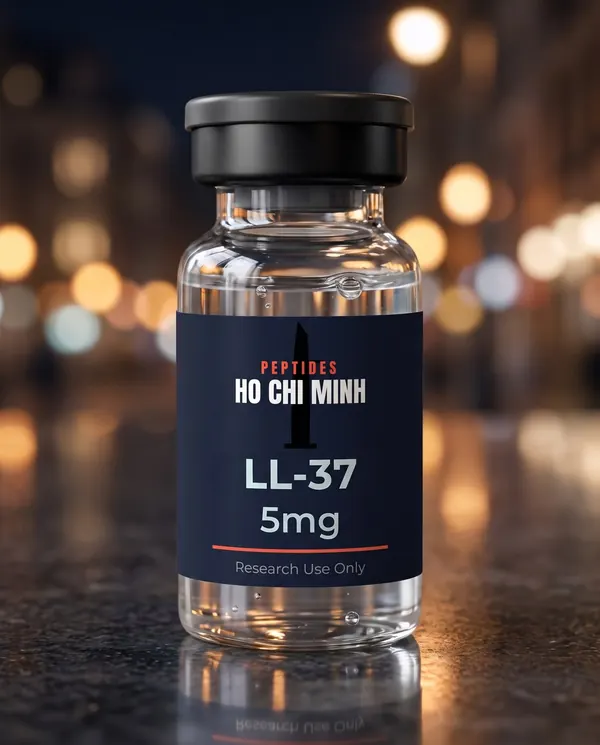
LL-37 5mg research vial
LL-37 is a natural 37 amino acid peptide and the only cathelicidin the human body makes; a 5mg vial is 3,000,000 VND ($120 USD). Each of the three LL-37 reviews below opens on PubMed, and Peptides Ho Chi Minh confirmed what it costs on 11 October 2026.
What is LL-37?
Immune cells and the cells that line the body release LL-37 to fight germs.
It can both raise and lower inflammation, depending on the setting.
Good to know
Papers also call it human cathelicidin, or a cathelicidin-related antimicrobial peptide, as two of the reviews below do in their PubMed titles. Search for those names too when you read the research.
LL-37 in lab reviews and ulcer trials
- Review, 2016. A review of lab work on LL-37 as a peptide that makes pores in bacteria and sends signals to immune cells.
- Review, 2016. A look at LL-37 research in the immune system, lungs, gut and skin, with a call for more study.
- Review, 2024. A skin review noted that many peptides like LL-37 have failed in clinical trials, and that some bacteria resist them.
Well studied in cells and animals. Two randomized trials tested an LL-37 product on long-lasting leg ulcers against a placebo: one in 2014 with 34 people, and a larger one in 2021 with 148 people. Both tracked the size of the ulcers over time, and the larger 2021 trial found no overall difference from placebo.
How to read this
LL-37 is a natural part of the body's defences, and lab studies look at how it attacks bacteria. Turning that into a product is a separate question. The two leg ulcer trials are the clearest test: 34 people in 2014, then 148 people in a larger 2021 trial, both against a placebo, and the larger trial found no overall difference from placebo. The 2024 review covers the hurdles between the lab and clinical use.
The LL-37 paper trail
Two of the reviews came out in 2016, and a skin review followed in 2024. Lab studies look at how LL-37 punches holes in bacteria. They also look at how it sends alarm signals to immune cells. Both are lab measures, a long way from a product you can buy.
Sources: PubMed record 26556394 (review, 2016); PubMed record 27117377 (review, 2016); PubMed record 39858288 (review, 2024); PubMed record 25041740 (2014 leg ulcer trial); PubMed record 34687253 (2021 leg ulcer trial).
How much does LL-37 cost per pack?
| Pack | Price | Per vial | Per mg |
|---|---|---|---|
| 1 vial | 3,000,000 VND ($120 USD) | 3,000,000 VND ($120 USD) | 600,000 VND ($24 USD) |
| 3 vials | 7,290,000 VND ($291.60 USD) | 2,430,000 VND ($97.20 USD) | 486,000 VND ($19.44 USD) |
| 5 vials | 10,800,000 VND ($432 USD) | 2,160,000 VND ($86.40 USD) | 432,000 VND ($17.28 USD) |
| 10 vials | 18,000,000 VND ($720 USD) | 1,800,000 VND ($72 USD) | 360,000 VND ($14.40 USD) |
Questions about LL-37
What has research on LL-37 looked at?
Germ fighting and immune signals in the lab. Two leg ulcer trials, from 2014 and 2021, set an LL-37 product against a placebo. The larger one, in 2021, found no overall difference.
What else is LL-37 called?
Papers also call it human cathelicidin. It is the only cathelicidin the human body makes.
Where can I buy LL-37 peptide?
On this page: LL-37 comes as a 5mg vial, priced in VND with the dollar figure beside it. Orders go through WhatsApp, delivery in Ho Chi Minh City is free, and the rest of Vietnam gets tracked parcels in 1 to 3 days.
How much research covers LL-37?
A lot: PubMed returned 2,552 records for LL-37 on 18 October 2026, mostly cell and animal work. Two leg ulcer trials point different ways: a 2014 trial in 34 people, and a larger 2021 trial in 148 people that found no overall difference from placebo.
By Peptides Ho Chi Minh, 11 October 2026