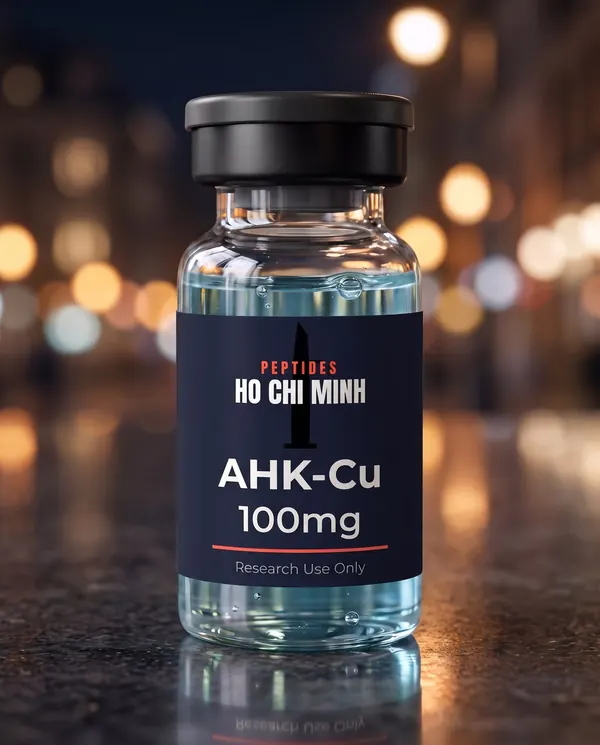
AHK-Cu 100mg research vial
AHK-Cu is a 3 amino acid peptide (alanine, histidine and lysine) joined to copper; one 100mg vial costs 2,500,000 VND ($100 USD). A single vial works out to 25,000 VND ($1 USD) per mg as checked on 11 October 2026, and the one AHK-Cu study below opens on PubMed.
What is AHK-Cu?
AHK is alanine, histidine and lysine in a row, and AHK-Cu is that peptide joined to copper. It is a close cousin of GHK-Cu.
Cousin does not mean twin. AHK-Cu has its own record, and it is a very small one. Everything our search found on it is hair and cosmetic lab work.
The name is a code: A, H and K are the one-letter symbols for alanine, histidine and lysine, and Cu is the chemical symbol for copper.
Good to know
If you want a copper peptide with a longer research record, GHK-Cu has decades of skin studies. AHK-Cu has one dish experiment on hair follicles. Both sit on the same shelf here, so you can compare the two pages side by side. The GHK-Cu page lists four studies; this one lists one.
AHK-Cu and its single lab study
- Cell study, 2007. Human hair follicles were grown in a dish with AHK-Cu. The team measured how long the follicles grew, and how fast dermal papilla cells, the hair root cells that control growth, multiplied.
That one lab study is the whole record our search found, with no animal or human trial. GHK-Cu studies do not carry over to AHK-Cu, so none are used here.
How to read this
One study is a starting point, not a record. The 2007 work grew human hair follicles in a dish and measured their length and how fast root cells multiplied. That is a clean lab test, but it says nothing about hair on a living scalp, and our search found no repeat in animals or people since. Because AHK-Cu and GHK-Cu share copper and a similar short shape, it is tempting to borrow GHK-Cu studies. This page does not, and you should not either.
The AHK-Cu paper trail
The single study ran in the Archives of Pharmacal Research in 2007. Its hair root cells were dermal papilla cells, the cells at the base of a follicle that steer hair growth. One dish study is the whole record, so this page does not borrow GHK-Cu research to fill the gap.
Sources: The effect of tripeptide-copper complex on human hair growth in vitro.
How much does AHK-Cu cost per pack?
| Pack | Price | Per vial | Per mg |
|---|---|---|---|
| 1 vial | 2,500,000 VND ($100 USD) | 2,500,000 VND ($100 USD) | 25,000 VND ($1 USD) |
| 3 vials | 6,075,000 VND ($243 USD) | 2,025,000 VND ($81 USD) | 20,250 VND ($0.81 USD) |
| 5 vials | 9,000,000 VND ($360 USD) | 1,800,000 VND ($72 USD) | 18,000 VND ($0.72 USD) |
| 10 vials | 15,000,000 VND ($600 USD) | 1,500,000 VND ($60 USD) | 15,000 VND ($0.60 USD) |
Questions about AHK-Cu
What has research on AHK-Cu looked at?
Hair research in a dish: one 2007 lab study on human hair follicles. Nothing in animals or people yet.
What is the difference between AHK-Cu and GHK-Cu?
Both are three amino acids joined to copper, and they share the last two, histidine and lysine. AHK-Cu starts with alanine and GHK-Cu with glycine. GHK-Cu has decades of skin research behind it, while AHK-Cu has one lab study on human hair follicles, so no GHK-Cu result is borrowed for this page.
By Peptides Ho Chi Minh, 11 October 2026